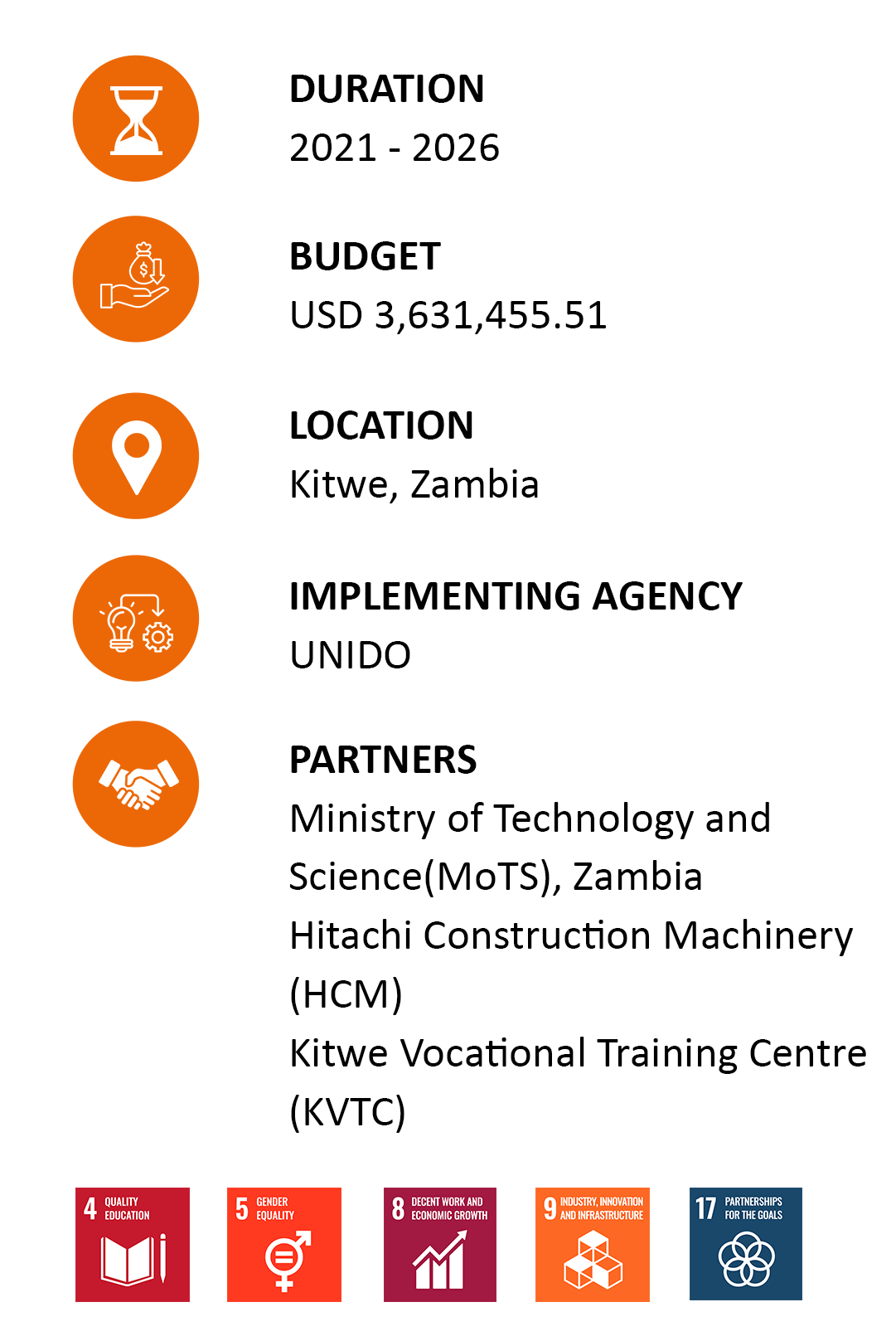
Project for Promoting Youth Employment Through Construction Equipment Operating Skills Training-KVTC HEO


Zambia's mines were expanding. The workers weren't ready.
Copper fuels 70% of Zambia's export earnings, yet the TVET system had no standardised curriculum for the operators who run the excavators, dump trucks, and loaders that keep those mines moving. Skilled youth existed; they just had nowhere to learn.
In 2021, the Government of Japan, the Government of Zambia, Hitachi Construction Machinery, and United Nations Industrial Development Organisation (UNIDO) agreed to create something unprecedented, a Public-Private Development Partnership to transform Kitwe Vocational Training Centre into a nationally recognised hub for heavy equipment operation training.
The initiative reflects a shared commitment to establish a Public-Private Development Partnership that enhances decent employment opportunities for Zambian youth by narrowing the gap between supply and demand for skills in heavy equipment operations.
Scroll through the project milestones
Before writing a single module, the team went out and listened. A Labour Market Survey and Training Needs Assessment reached 651 mining and construction firms across the Copperbelt, Lusaka, and Northwestern provinces. The message was unambiguous: Zambia urgently needed standardised, competency-based training for heavy equipment operators.
Three nationally accredited curricula, written from scratch, approved by TEVETA. In partnership with TEVETA, industry experts, and project partner Hitachi Construction Machinery, the team developed, validated, and obtained approval for three Skills Award curricula: Excavator Operations, Dump Truck Operations, and Front-End Loader Operations. This was the first formally standardised operator training curriculum in Zambia's history.
KVTC Trainers Sharpen Practical Skills Through Hands-On Machinery Training in Japan. Five KVTC technical staff undertook a series of six staff development programmes, including two study tours to Hitachi's facilities in Zambia and Japan, hands-on training at First Quantum Minerals' Kalumbila Mine, and specialist excavator training at HCMZ. They returned different people: exposed to world-class equipment, standards, and practices they would now teach.
A training circuit rises. Real machines arrive on site. Design reviews, permits, and groundwork reshaped KVTC. Renovations were completed for a partitioned simulator lab and lecture room, while plans advanced for a specialised HEO workshop and reinforced training circuit. The project procured a Hitachi excavator, front-end loader, and dump truck — the first training machines KVTC had ever owned. A reinforced training circuit transformed a basic practice yard into a realistic simulated worksite.
Twenty-five pioneers sit in Zambia's first accredited HEO class. The pilot Excavator Operations cohort began training in 2024. Twenty-five young people, including 11 women became the living proof that the project was real. Every module they completed, every practical hour they logged, validated years of preparation. Thirteen graduated. The journey from curriculum to classroom was complete.
Excavator, Dump Truck, and Front-End Loader, running at once for the first time. 2025 marked the turning point. KVTC moved from pilot delivery to full-scale concurrent operations. Nine training intakes ran across three programmes. 185 students graduated in this period alone. The institution had become what the project always envisioned — a functioning, multi-programme training hub.
Women account for 31% of cumulative enrolment. Targeted awareness campaigns, media outreach, national exhibitions and community engagement helped increase women’s participation in traditionally male-dominated heavy equipment operations. By October 2026, 218 women had enrolled, representing 31% of the 703 trainees. Of the 333 confirmed graduates, 91 were women, highlighting progress in expanding women’s access to technical skills.
100% positive employer feedback across five competency areas. Feedback from 22 managers showed that all rated supervised graduates positively for quantity and quality of work, work ethic, job knowledge and competency, and teachability. These findings indicate that graduates demonstrate promising workplace readiness and capacity to learn.
201 company visits. 16 industry partnership engagements. 33% graduate employment. The Career Services Centre strengthened employer engagement, job referrals and graduate follow-up. KVTC established six signed Memoranda of Understanding and ten Expressions of Interest, exceeding its target of ten partnership engagements. The Centre contacted 188 trainees and graduates against a target of 150, while the tracer study found that 33% of responding graduates had secured gainful employment six months after graduation, below the 60% target.
703 trainees enrolled, supported by multiple funding pathways. Cumulative enrolment exceeded the original target of 300, reaching 703 trainees, including 218 women. Government-supported TVET bursaries funded 322 trainees, while 119 benefited from Constituency Development Fund sponsorships. A further 112 trainees received project support, and 150 were self-sponsored, demonstrating the importance of diversified financing in expanding access to specialized technical training.
Watch the transformation of KVTC's Heavy Equipment Operator Workshop — from a basic yard to a nationally recognised training facility.
The workshop now features two fully equipped classrooms, three operational parking bays, and a reinforced training circuit — increasing annual trainee output from 125 to approximately 300.
On 25 March 2026, representatives from the Embassy of Japan, Zambia's Ministry of Technology and Science, TEVETA, Hitachi Construction Machinery, UNIDO, and industry partners gathered at KVTC for the formal handover of the new Heavy Equipment Operator Workshop. The facility, featuring two fully equipped classrooms, and three operational parking bays, was handed over to KVTC. What was once a basic yard is now a nationally recognised workshop.
The new facility has strengthened KVTC's training infrastructure and enhanced its capacity to deliver industry-aligned HEO training, increasing the expected annual output from 125 to approximately 300 trainees.

Measurable Change
Final results of the HEO project, November 2021 – November 2026
young Zambians graduated as heavy equipment operators
in Excavator, Front-End Loader and Dump Truck Operations, reaching 133% of the target of 250 graduates.
Trainees Enrolled
234% of the target of 300
218 women (31%)
Completion Rate
333 graduates from completed cohorts
Female Graduates
from negligible participation at inception
Employment Rate
of graduates in work
Accredited HEO Curricula
300% of the target of one
Training of Trainers Sessions
110% of the target of 10
In Assets Provided to KVTC
USD 1,233,838, 123% of the USD 1 million target
Awareness & Enrolment Campaigns
about 2,140 applications received
MoUs & Expressions of Interest
from a baseline of zero
Graduates Government-Financed
49%: CDF (38) and TEVET bursaries (125)
Trainee Satisfaction
89% also said the content could be applied in their jobs
Employer Satisfaction
with graduates
Real lives transformed through skills, opportunity, and determination
Nancy Chanda
"I had nothing. I was nothing. But now I'm earning, supporting my family, and living the life I once dreamed of."
She came to KVTC without a job. She left with a certification, and a profession. Nancy is now an excavator operator at Jewel of Africa Mining Company.
Christine Kalizya
"The skills I gained at Kitwe Vocational Training Centre (KVTC) did not just give me a job; they gave me a future. I can now support my family and stand on my own feet. I refused to let my story end in my village."
Christine is now a heavy equipment operator at Zambeef Chiawa Farms.
A powerful coalition driving excellence in skills development


In collaboration with Ministry of Technology & Science, TEVETA, and industry leaders.
Partner with KVTC to shape the next generation of heavy equipment operators. Explore training, sponsorships, or recruitment pathways.